From Nijmegen to the Netherlands East Indies and Australia
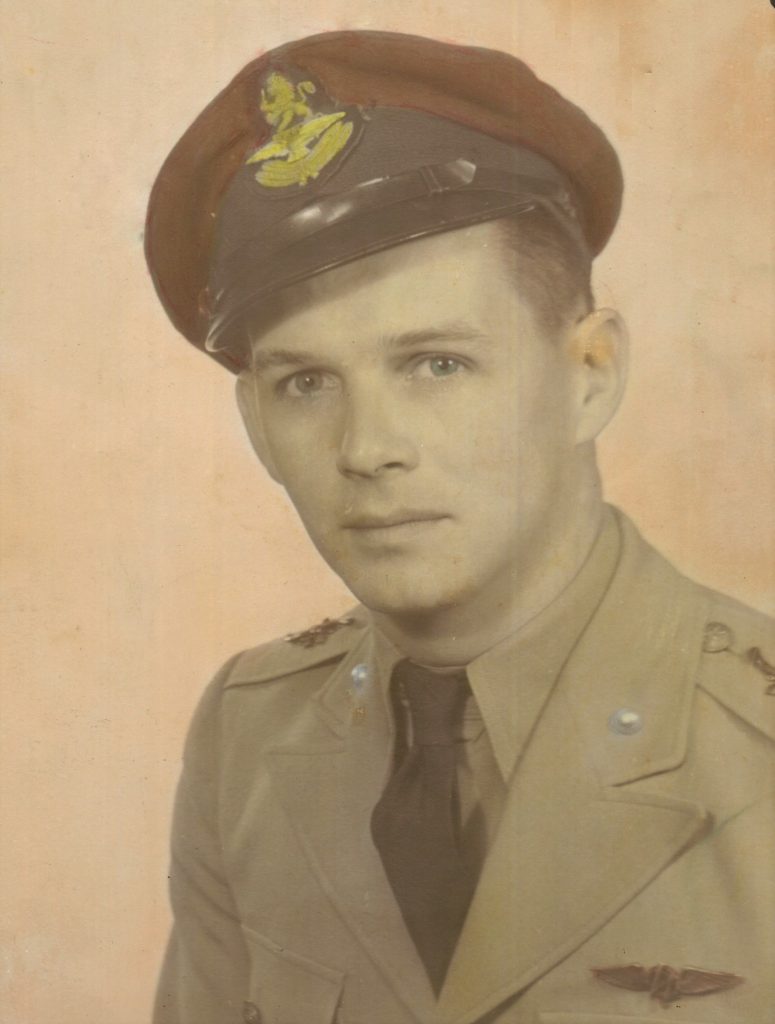
Joop van Doorn was a Dutch military wireless operator, telegraphist and navigator whose wartime service connected the Netherlands East Indies, Australia, India and the Allied air campaign against Japan.
He flew in Glenn Martin bombers and Lockheed Lodestar transports, participated in the evacuation of military personnel and civilians from Java, escaped to Australia with his wife Fatima and became one of the original Dutch members of No. 18 (Netherlands East Indies) Squadron RAAF.
His subsequent postings connected him with several Dutch aviation organisations in Australia, including the Personnel and Equipment Pool, the proposed No. 119 Squadron and the Netherlands East Indies military air transport service.
After further service in the Netherlands East Indies, Joop and his family migrated permanently to Australia in 1954 and settled in Brisbane.
Early service in the Netherlands East Indies
Joop was born in 1919 and came from the Nijmegen region of the Netherlands. He travelled to the Netherlands East Indies before the war and began serving as a military wireless operator in 1939.
He initially flew aboard Glenn Martin B-10 bombers. A wireless operator was an essential member of a bomber crew, maintaining radio contact, transmitting and receiving messages and assisting with navigation.
Joop was later transferred to a transport squadron operating Lockheed Lodestar aircraft. As the Japanese threat intensified, these aircraft carried military personnel, officials, civilians and supplies between Java and other parts of the Netherlands East Indies, India and Australia.
General Wavell and the formation of ABDACOM
Joop regularly flew with Reserve First Lieutenant Yves Henri “Bels” Mulder, a pilot whose nickname referred to his Belgian origins.
On 10 January 1942, Mulder and Van Doorn formed part of the crew of Lockheed Lodestar LT-925 carrying British General Sir Archibald Wavell to Kemajoran Airport near Batavia. Wavell had been appointed supreme commander of the newly created American-British-Dutch-Australian Command—ABDACOM—and was travelling to Java for its inaugural meetings.
The former DACC article incorrectly combined Wavell’s name with that of Lieutenant-General Arthur Percival, the British commander in Malaya and Singapore. They were two different officers.
Mulder later served with No. 120 (Netherlands East Indies) Squadron RAAF. He was killed near Merauke on 19 November 1944 while flying P-40 Kittyhawk C3-553.
Read the related DACC article: The American-British-Dutch-Australian Command—1942.
Evacuating personnel from Java
As Japanese forces advanced, Joop and the other Lodestar crews worked intensively to evacuate people from Java.
In a 2005 interview, he recalled carrying military personnel and civilians to Australia and India. Some flights continued through Borneo and Celebes, while others followed the long route through Broome and the inland Australian airfields to Brisbane and Sydney.
One flight carried a senior officer associated with Dutch military and government purchasing operations and his family to Sydney. Joop and the crew then returned to Java and resumed evacuation flights.
Another Lodestar carried a full load of military personnel to India. The crews frequently flew at night and sometimes returned to Java almost immediately after completing a long-distance flight.
Joop described their objective simply: to evacuate people “as fast as we could”.
The final escape from Java
After completing a flight from India, Joop was told by his commanding officer to report again at 11.30 that night with his wife and only a few suitcases. He was warned that they would not be returning.
Joop and Fatima had been married for only about two months.
On 5 March 1942, they departed Java aboard Lockheed Lodestar LT-925 with several other families. The aircraft reached Western Australia while the north-western air route remained under threat following the Japanese attack on Broome two days earlier.
Different surviving accounts identify stopping or refuelling points that included Anna Plains, Port Hedland and Geraldton. Joop’s 2005 recollection states that they landed at Port Hedland, continued to Geraldton and then reached Perth, where the Lodestar required maintenance.
The aircraft’s occupants were initially ordered to return to Java. At Geraldton, however, they received the message that the return flight was no longer required because Java had fallen.
For Joop, Fatima and the other families aboard the Lodestar, the journey became a permanent evacuation rather than another temporary transport assignment.
Melbourne and Canberra
From Perth, Joop, his fellow servicemen and their families travelled to Melbourne. They were accommodated for approximately three weeks at the Victoria Palace Hotel while Dutch and Australian authorities considered how the surviving Netherlands East Indies forces should be reorganised.
They subsequently moved to Canberra, where No. 18 (Netherlands East Indies) Squadron RAAF was being established.
Joop was among the first Dutch personnel attached to the squadron. He served as a wireless operator, telegraphist and navigator.
From Canberra, No. 18 Squadron initially undertook training and maritime-patrol duties along Australia’s eastern coast. After receiving and preparing its B-25 Mitchell bombers, the squadron moved to the Northern Territory and began attacking Japanese shipping, airfields and military installations throughout the occupied Netherlands East Indies.
Read the wider squadron history: No. 18 (Netherlands East Indies) Squadron RAAF.
Other wartime postings
Joop’s wartime career was not confined to No. 18 Squadron. His surviving service record and family history also connect him with:
- the Netherlands East Indies Personnel and Equipment Pool;
- the proposed No. 119 (Netherlands East Indies) Squadron;
- Netherlands East Indies transport operations; and
- the organisation that ultimately became No. 19 (Netherlands East Indies) Transport Squadron.
These postings drew upon Joop’s experience with wireless communications, navigation, bombers and long-distance transport aircraft.
No. 119 Squadron was intended to become a second Dutch B-25 bomber squadron but did not become operational. Dutch transport units, meanwhile, maintained communications and supply routes between Australian bases, New Guinea and the Netherlands East Indies.
Decorations
Joop van Doorn received several Dutch decorations in recognition of his wartime and postwar service:
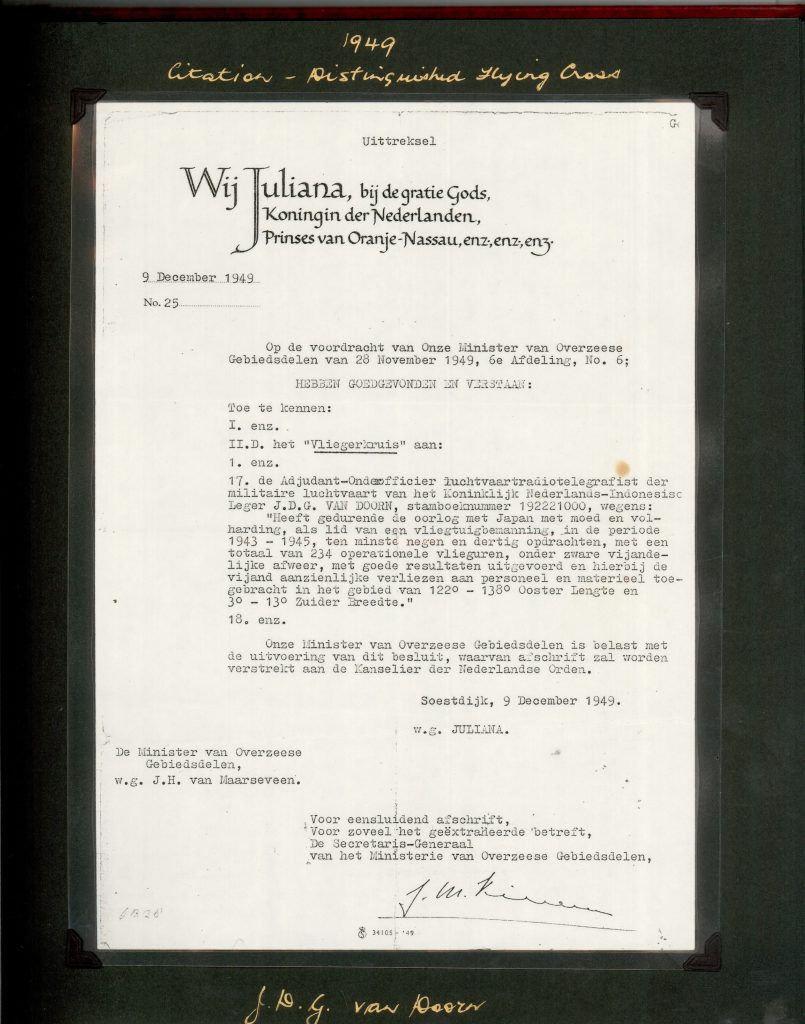
- the Vliegerkruis—Flying Cross;
- the Oorlogsherinneringskruis—War Commemorative Cross; and
- the Ereteken voor Orde en Vrede—Decoration for Order and Peace.
The Vliegerkruis was one of the Netherlands’ principal decorations for courage and distinguished conduct during military aviation operations.
Return to the Netherlands East Indies
Joop and his family returned to Java in late 1947, during the Indonesian struggle for independence.
The deteriorating political and military situation resulted in another family separation. Fatima and the children left Indonesia for the Netherlands in late 1949. Joop remained until 1950 and returned to the Netherlands following the transfer of sovereignty to Indonesia.
Family information records that three of Joop and Fatima’s children were born in Australia between 1942 and 1947. Further children were born before the family returned permanently to Australia, and two more were born in Brisbane between 1955 and 1958.
Migration to Brisbane
In 1954, Joop, Fatima and their children migrated permanently to Australia and settled in Brisbane.
Joop remained active within Brisbane’s Dutch community. He was a longstanding member of the Dutch Club and attended activities at the Bambu community centre.
His life therefore extended beyond his military service. Like a number of former Netherlands East Indies servicemen, he became part of the postwar Dutch migration story and helped establish a Dutch community in Australia.
Joop died in 2016 at the age of 96.
Joop’s reflections on Australia’s defence
At a gathering of No. 18 Squadron veterans on the Gold Coast on 22 July 2005, Joop was interviewed by Sue Summers for the Migration and Ethnicity Research Centre at Curtin University.
He recalled that Australians in early 1942 did not fully understand the speed of the Japanese advance or the danger confronting their country. Many Australian troops were still serving in the Middle East, while Dutch personnel arriving from the collapsing Netherlands East Indies had witnessed the Japanese advance directly.
Joop believed that the resistance offered in the Netherlands East Indies delayed Japan’s advance and contributed to Australia’s defence. When asked whether the Dutch role had received sufficient recognition in Australia, he replied:
“I don’t think so … still to this day.”
The interview is valuable because Joop discusses his experiences in his own words while consulting his wartime flying logbook.
Military documents
The following four documents form part of Joop van Doorn’s surviving military record.
This service record summarises Joop’s military career, postings, promotions, decorations and periods of service. Although some parts of the surviving copy are difficult to read, the document remains an important primary record of his military career.
Statement of military service
Military record document
This document forms part of the surviving group of records relating to Joop’s wartime aviation service.
Additional service record
This document contains further administrative information about Joop’s military service and postings.
Interview with Joop van Doorn
The complete transcript of Sue Summers’s 2005 interview is available below as a separate downloadable document. It preserves Joop’s recollections of his early service, evacuation flights, escape with Fatima, arrival in Australia, formation of No. 18 Squadron and views about recognition of the Dutch contribution to Australia’s defence.
Historical significance
Joop van Doorn’s story connects several important parts of Dutch–Australian history:
- the prewar Netherlands East Indies air force;
- Glenn Martin bombers and Lockheed Lodestar transports;
- the establishment of ABDACOM;
- the evacuation of Java;
- the Broome air route and Western Australian airfields;
- the formation of No. 18 Squadron in Canberra;
- Dutch military transport operations from Australia;
- the Indonesian struggle for independence; and
- postwar Dutch migration to Brisbane.
His documents, flying records and interview provide a valuable personal record of the Dutch airmen and their families who escaped to Australia and subsequently made it their home.
Related DACC articles
- DACC Air Force Research Portal
- No. 18 (Netherlands East Indies) Squadron RAAF
- The American-British-Dutch-Australian Command—1942
- The Java–Broome evacuation route, February and March 1942
- No. 119 (Netherlands East Indies) Squadron RAAF
- Netherlands East Indies military air transport services in Australia, 1942–1947
- The NEI Personnel and Equipment Pool—Canberra and Bundaberg
- Dutch Club Brisbane and the Bambu community centre
Sources and acknowledgements
- Joop van Doorn, interview by Sue Summers for the Migration and Ethnicity Research Centre, Curtin University, No. 18 Squadron veterans’ gathering, Gold Coast, 22 July 2005.
- Joop van Doorn’s surviving military service and decoration records.
- Information and family material supplied by Ingrid Schodel.
- Netherlands War Graves Foundation, Yves Henri Mulder.
- No. 18 Squadron children and family-history collection.