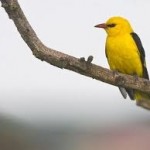
The Douglas DC-3 now preserved at the Queensland Air Museum in Caloundra has an exceptional Dutch–Australian history. Built for KLM in 1937 and named Wielewaal—Dutch for Golden Oriole—it served on the Amsterdam–Batavia route, escaped from Java carrying Lieutenant Governor-General Hubertus van Mook, entered Allied military service in Australia and was subsequently operated by Australian airlines for more than 25 years.
It is now recognised as Australia’s oldest surviving DC-3.
Built for KLM
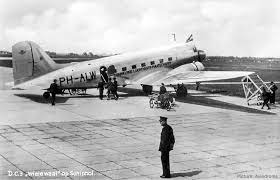
The aircraft was a Douglas DC-3-194B, construction number 1944. It was the 67th DC-3 completed and the tenth purchased by KLM.
It entered the Dutch aircraft register as PH-ALW on 12 April 1937 and was named Wielewaal. Configured for KLM’s long-distance service, it carried eleven passengers in reclining sleeper seats and had its passenger door on the starboard side.
The aircraft made its first flight at Santa Monica, California, on 24 April 1937. It was then flown to New York, dismantled and loaded aboard the SS Pennland for shipment to the Netherlands.
After arriving in Rotterdam, it was reassembled at Waalhaven by a team of KLM engineers that included Joop Gijzemijter. Gijzemijter would later serve with the Netherlands East Indies military air transport organisation at Archerfield Airport in Brisbane.
Read the related DACC article: Joop Gijzemijter at the Netherlands East Indies Transport Service.
Transfer to KNILM
Following the German invasion of the Netherlands and the interruption of KLM’s European operations, the aircraft was transferred to the Netherlands East Indies. On 1 June 1940 it was entered on the Netherlands East Indies register as PK-ALW and operated by KNILM.
During the final months before the Japanese invasion, the aircraft was camouflaged and used for increasingly urgent civil and military transport duties.
On 14 February 1942, it left Calcutta for Akyab and Medan. At Medan, its seats were removed to accommodate 36 women and children being evacuated to Batavia. It arrived there on 15 February, the day Singapore surrendered.
Van Mook’s evacuation from Java
On 2–3 March 1942, PK-ALW carried one of the final cargo loads from Port Hedland in Western Australia to Andir airfield near Bandung.
Because Andir was exposed to Japanese attack, Captain Eddy Dunlop subsequently positioned the aircraft on the unfinished Boeabatoe Road outside Bandung. This road had been prepared for use as a concealed emergency landing ground.
The aircraft remained there awaiting Lieutenant Governor-General Hubertus van Mook, senior officials and KNILM personnel who had been ordered to leave Java and continue the Netherlands East Indies administration from Australia.
At approximately 1 a.m. on 7 March 1942, PK-ALW departed while fighting was taking place at Lembang, less than fifteen kilometres away. The aircraft had been stripped of its normal passenger fittings, and its occupants reportedly sat on the floor, using a rope stretched through the cabin for support.
Captain Eddy Dunlop commanded the aircraft, with Evert Herman van Hummel serving as flight engineer. After a nonstop flight of seven hours and 32 minutes, the aircraft landed safely at Port Hedland.
It was the final KNILM civil aircraft to escape from Java before the Netherlands East Indies capitulated.
Contemporary record of Van Mook’s arrival
The following downloadable document records Van Mook’s arrival in Australia aboard the Wielewaal and forms part of the contemporary documentation of the Netherlands East Indies administration’s evacuation from Java.
Under the Sydney Harbour Bridge
After the surviving KNILM aircraft reached Australia, the American command arranged to take them over for Allied military transport operations.
On 14 May 1942, ten former KNILM aircraft took part in simultaneous test flights over Sydney. Several flew low over the Dutch cruiser Tromp, which was berthed at Woolloomooloo.
Three aircraft then passed under the Sydney Harbour Bridge in formation—first in one direction and then back again:
- the DC-2 PK-AFK, flown by Captain Frans van Breemen;
- the DC-3 PK-ALW Wielewaal, flown by Captain Peter Deenik; and
- the DC-5 PK-ADC Wakago, flown by Captain Dirk Rab, with Joop Gijzemijter as flight engineer.
The flight has often been described as a Dutch protest against the transfer of the KNILM aircraft. It was also an extraordinary demonstration by crews who were about to lose direct control of the aircraft with which they had escaped from the Netherlands East Indies.
Read the related DACC article: Dutch aircraft flew under the Sydney Harbour Bridge.
Allied military service
The aircraft was taken into American-controlled military service and initially identified by its construction number, 1944. It subsequently operated with the radio call sign VHCXE and later VH-CXL. It also received the United States Army Air Forces serial number 44-83229.
In June 1942, the aircraft was fitted with seven passenger seats and assigned for use by General Douglas MacArthur’s General Headquarters. MacArthur used it on at least one documented journey from Melbourne to Canberra and return for a meeting with Australian Prime Minister John Curtin.
The Wielewaal was subsequently used by MacArthur’s headquarters to transport senior personnel and communications. It also operated in support of Allied activities in New Guinea.
During 1943 and 1944, the aircraft passed through several administrative and operational arrangements involving the USAAF, the RAAF and Australian National Airways. It served with No. 36 Squadron RAAF at Townsville before being handed over for operation by Australian National Airways in April 1944.
These changing identities illustrate the complicated arrangements under which former Dutch civilian aircraft were absorbed into the Allied transport system.
Postwar Australian airline service
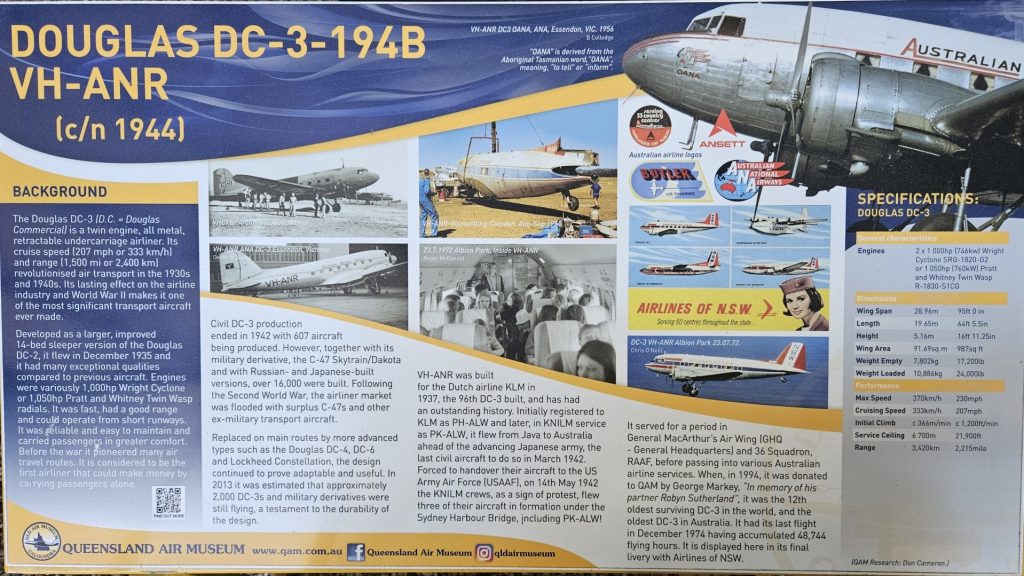
After the war, the aircraft was formally registered to Australian National Airways as VH-ANR in May 1946 and named Oana, an Aboriginal word interpreted as “to inform”.
It later operated with Butler Air Transport and Airlines of New South Wales. In 1958 it was converted to the distinctive “Viewmaster” configuration, with enlarged passenger windows intended to improve sightseeing.
The aircraft was finally withdrawn from airline service in 1972. By then, it had accumulated close to 50,000 flying hours and had served successively in Dutch, Netherlands East Indies, American and Australian operations.
Preservation in Queensland
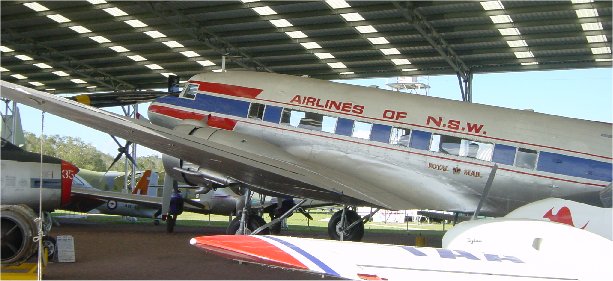
After passing through several private owners, VH-ANR was donated to the Queensland Air Museum by George Markey on 18 February 1994.
The dismantled aircraft arrived at Caloundra aboard two semi-trailers on 15 September 1994. Museum volunteers subsequently restored it for static display.
The aircraft is displayed in its Airlines of New South Wales colour scheme. Although its wartime Dutch and Allied identities are of great historical importance, retaining the later Australian appearance also records its long postwar airline service.
The Wielewaal name continues
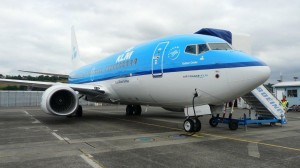
KLM revived the name Wielewaal in 2011 when it applied it to one of its Boeing 737-700 aircraft. This reflected KLM’s tradition of naming aircraft after birds and preserved the name of the historic DC-3.
Why this aircraft matters
The surviving aircraft brings together several important elements of Dutch–Australian history:
- KLM’s prewar Amsterdam–Batavia service;
- KNILM operations in the Netherlands East Indies;
- the final evacuation from Java;
- the establishment of the Netherlands East Indies Government-in-Exile in Australia;
- the transfer of Dutch civil aircraft into Allied military service;
- MacArthur’s General Headquarters;
- RAAF and Australian National Airways transport operations; and
- postwar Australian regional aviation.
Its preservation in Queensland means that one of the most important surviving objects from the Dutch wartime presence in Australia remains publicly accessible.
Detailed aircraft history
The following downloadable document provides a more detailed chronological history of Douglas DC-3-194B, construction number 1944, from its completion in 1937 through its Dutch, wartime and Australian service and its eventual preservation at Caloundra.
Related DACC articles
- DACC Air Force Research Portal
- KNILM and its Australian connection
- From Java to Charleville: the extraordinary wartime journey of the Douglas DC-5 Wakago
- Joop Gijzemijter at the Netherlands East Indies Transport Service
- Evert Herman van Hummel survived a Catalina crash in 1945
- Netherlands East Indies military air transport services in Australia, 1942–1947
Sources and further reading
Queensland Air Museum—Douglas DC-3 VH-ANR
Aussie Airliners—VH-ANR aircraft history
Aviation Museums National Network—Douglas DC-3 VH-ANR
ADF Serials—Douglas C-47, C-49, C-50 and C-53
The aircraft’s preservation at the Queensland Air Museum was also featured in the Sunday Mail, 9 February 2003, p. 5.